
Mi PowerBank 3i Teardown & Should Cost Analysis Teardown & Cost Analysis
Comprehensive teardown of the Mi PowerBank 3i 20000mAh. Detailed BOM analysis with should-cost estimation benchmarked at ?1,436 against a retail price of ?1,609.
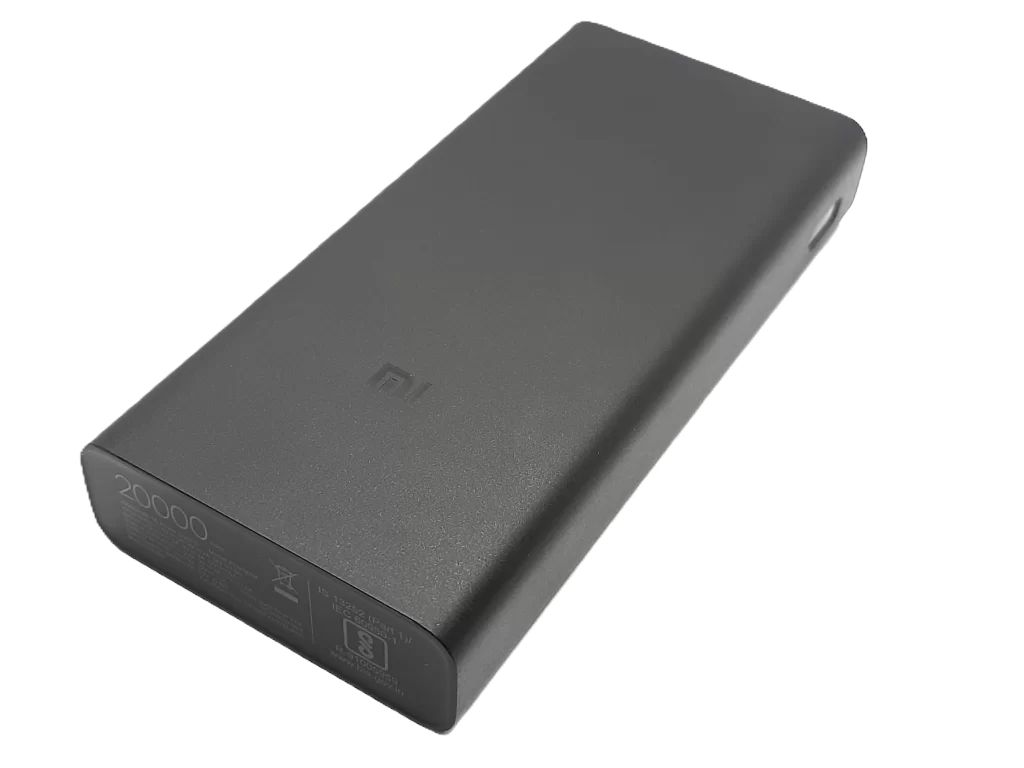
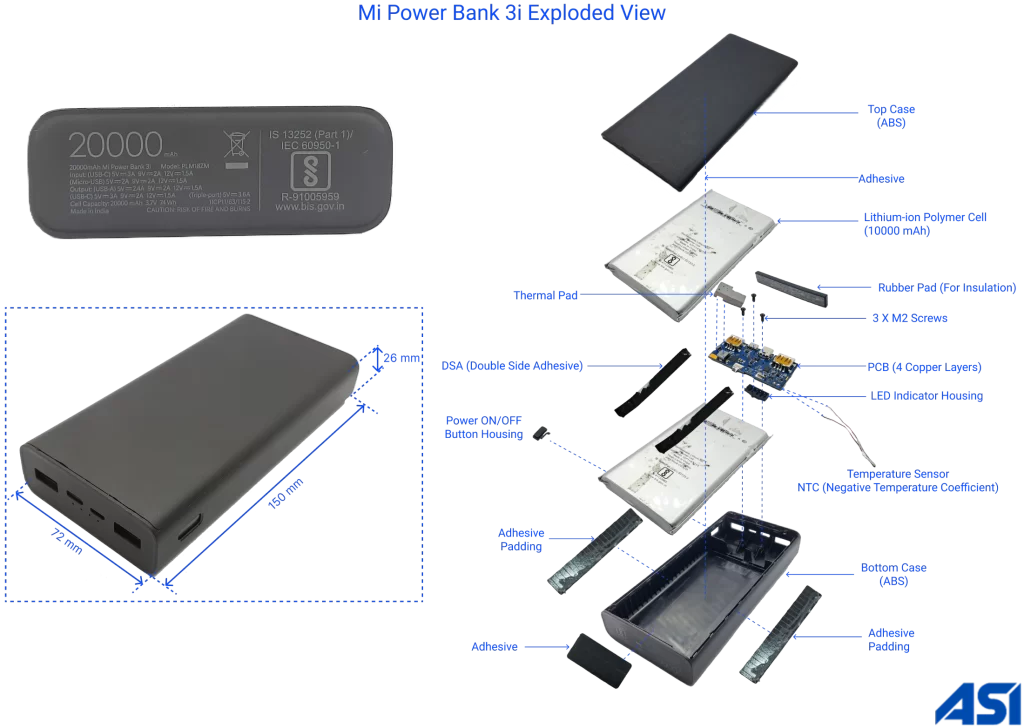
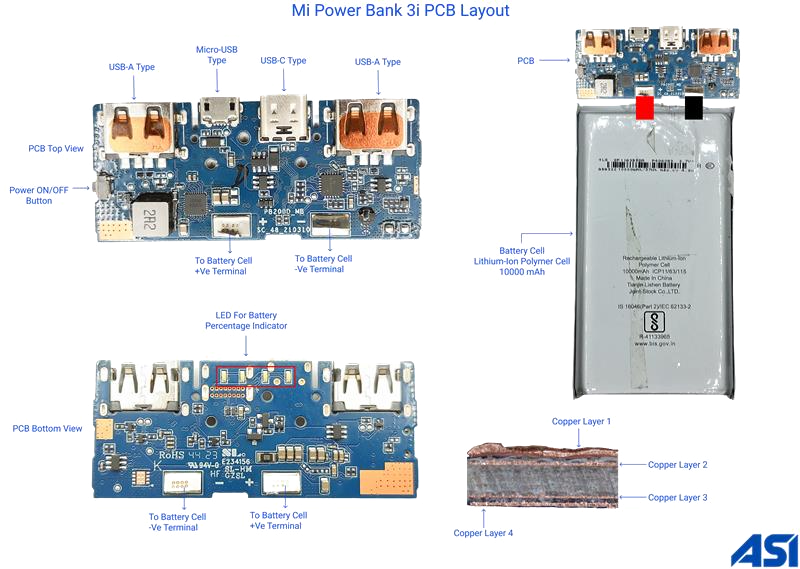
We have conducted a detailed teardown of a power bank, mapped its bill of material and calculated its should cost.
We recently purchased the Mi 20000 mAh power bank for ?1,609, while it is currently listed on the Mi website for ?1,891. Our estimated should-cost for the product is ?1,436. Additionally, the same power bank was exported from India to Bhutan at ?1,571 in the month of March 2024.
10,000mAh Lithium Polymer Battery, 18W Fast Charging with PD technology, Dual input (Micro-USB and USB-C), Triple output (USB-A 2 and USB-C), 12-layer circuit protection system, ABS plastic enclosure with matte finish, 150 72 26 mm, approximately 508 grams.
Complete BOM breakdown with 40 parameters per part, multi-level BOM structure, assembly-wise weight distribution analysis, manufacturing category distribution, and detailed should-cost breakdown with Pareto analysis.


01Product Overview
Prominent Features of Mi Power Bank 3i
Introduction
The Mi Power Bank 3i is a compact, high-capacity portable charger designed to charge all smart devices with efficiency. Designed for users needing reliable and fast charging on the go, this power bank comes packed with essential features.
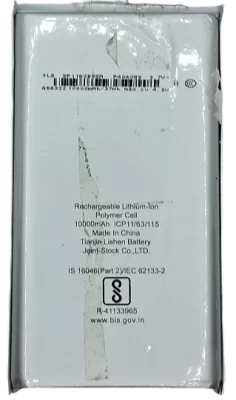
Battery Technology: Lithium-ion Polymer (High Density Batteries). The cells are rechargeable.
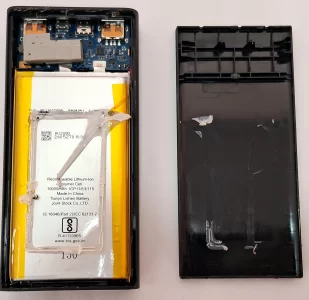
Cell Configuration: Each cell has a capacity of 10000 mAh and two cells are sandwiched to get 20000 mAh capacity. 2P (Two cells in Parallel configuration). The cells are sandwiched together inside the power bank.
Product Views
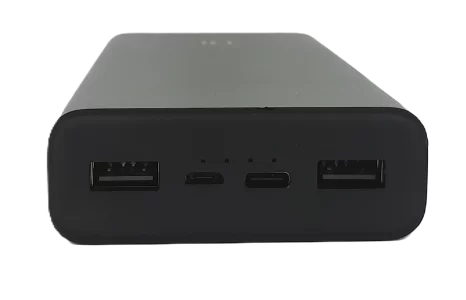
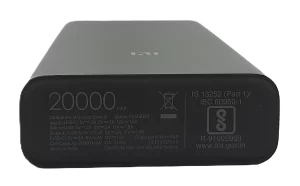
Safety Features 12-Layer Circuit Protection
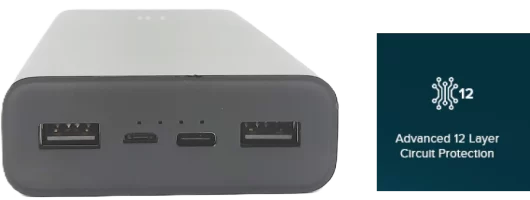
Safety is a cornerstone of the Mi Power Bank 3i. The device incorporates a twelve-layer circuit protection system, ensures maximum safety for both the power bank, and connected devices. The 12-layer circuit protection system includes:
- Over-current Protection
- Over-charge and Over-discharge Protection
- Short Circuit Protection
- Temperature Protection
- Reset mechanism for power recovery in abnormal conditions
Charging Technology
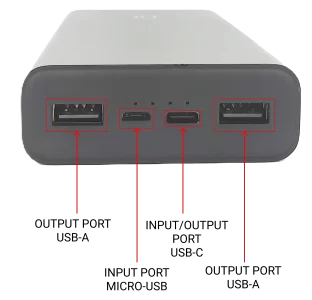
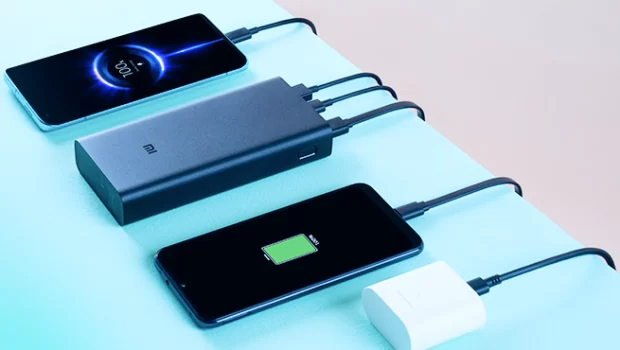
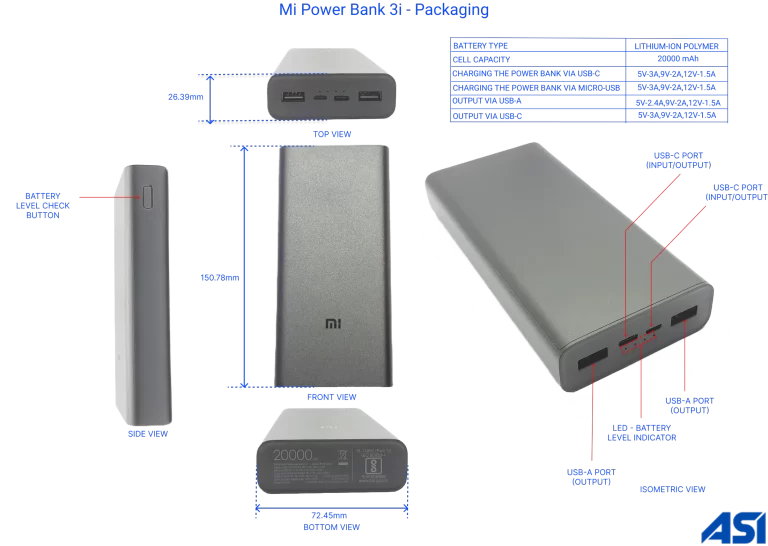
The Mi Power Bank 3i offers dual input (Micro-USB and USB-C) and triple output (USB-A and USB-C), allowing simultaneous charging of three devices. With 18W fast charging, it delivers quick power to compatible devices, while the low-power mode ensures safe charging for delicate gadgets like fitness trackers, activated with a double-press of the power button.
- Fast Charging: Supports 18W fast charging with Power Delivery (PD) technology
- Dual Input Ports: Micro-USB and USB-C inputs for versatile charging
- Dual Output Ports: Two USB-A and one USB-C output ports supporting simultaneous charging
- Trickle Charging Mode: Dedicated mode for low-power devices such as smartwatches and Bluetooth earbuds

Enclosure Design
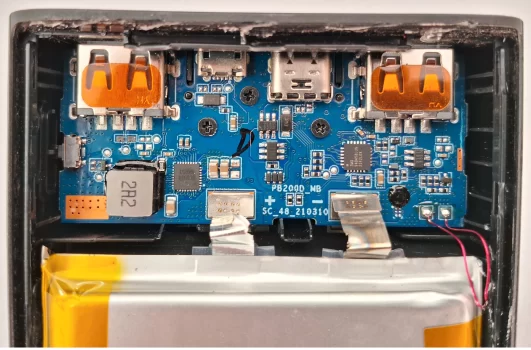
Our teardown of the Mi Power Bank 3i reveals its meticulous internal design, highlighting high-quality components and advanced safety mechanisms. The Mi Power Bank 3i features a durable ABS plastic enclosure with a sleek matte finish for heat resistance and scratch protection. The components are securely assembled using Adhesive Padding and DSA (Double-Side Adhesive) for enhanced durability and a compact, seamless design ensures easy portability for on-the-go convenience.
- Housing Material: High-strength ABS (Acrylonitrile Butadiene Styrene) plastic for durability and heat resistance
- Feel and Finish: Matte finish for a premium feel and scratch resistance
- Dimensions and Weight: 150 72 26 mm, compact for portability and lightweight approximately 508 grams
02BOM & Weight Analysis
Multi-Level BOM Structure
We conducted a detailed teardown of the Mi Power Bank 20000mAh to study its components and system architecture. This teardown study involved analyzing data related to various part attributes, enabling a comprehensive understanding of its design and functionality.
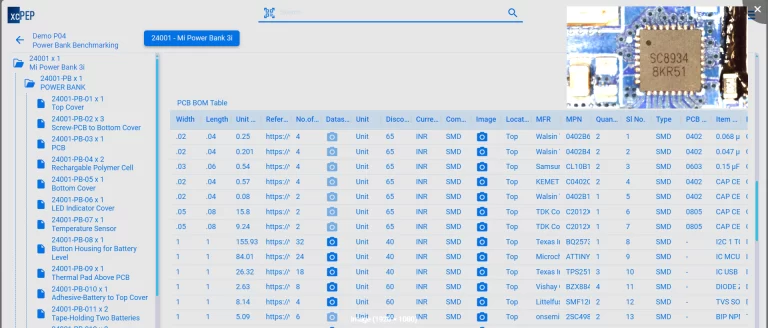
After teardown for this analysis, we used a Multi-level BOM (Bill of Materials) structure, which provides detailed insights into the main assemblies, their sub-assemblies, and individual components.
Summary of Assemblies and Components
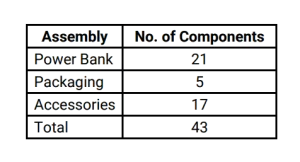
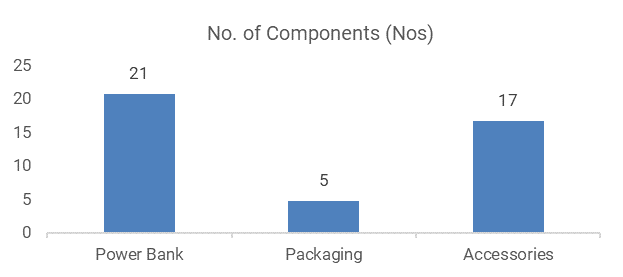
After teardown, 3 assemblies and 43 components were identified in the Mi Power Bank 20000mAh.
Component Parameters: Additionally, 40 BOM (Bill of Materials) parameters such as weight, dimensions, material type, electrical specifications, and thermal properties were mapped. On average, 20 parameters per part were recorded, depending on the complexity of the component.
Weight Distribution Overview
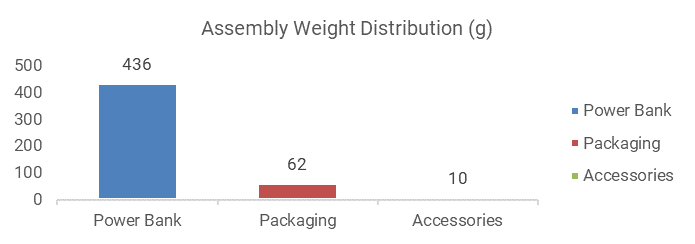
The total weight of the Mi Power Bank 3i (including power bank, packaging, USB cable) is 508 grams. The weight distribution of the assemblies is as follows:
- Power Bank: 85.86% (436 grams)
- Packaging: 12.18% (62 grams)
- Accessories: 1.96% (10 grams)
Major Components Weight Contribution:
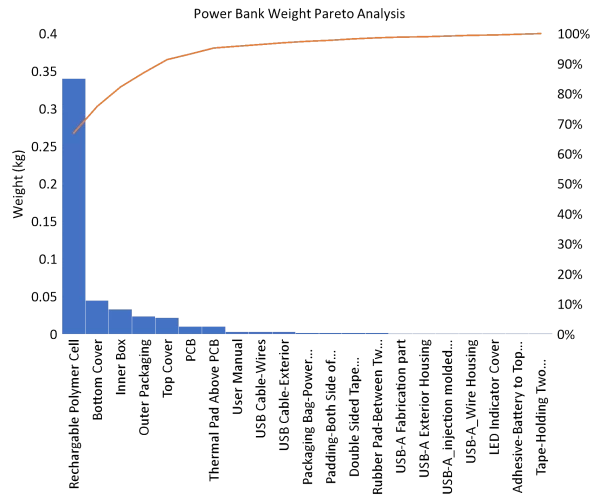
- Rechargeable Polymer Cell: 73% (339.99 grams)
- Bottom Cover: 10% (45.27 grams)
- Packaging (Inner Box and Outer): 12.3% (57.4 grams)
- Top Cover: 4.7% (22.09 grams)
Weight Pareto Analysis
The Rechargeable Polymer Cell is the heaviest component, weighing 339.99 grams (73% of the total weight). The Bottom Cover contributes 45.27 grams (10% of the total weight). Packaging materials (Inner Box and Outer Packaging) together weigh 57.4 grams (12.3% of total weight). The Top Cover is lightweight yet durable, weighing 22.09 grams (4.7% of total weight).
Manufacturing Category Distribution
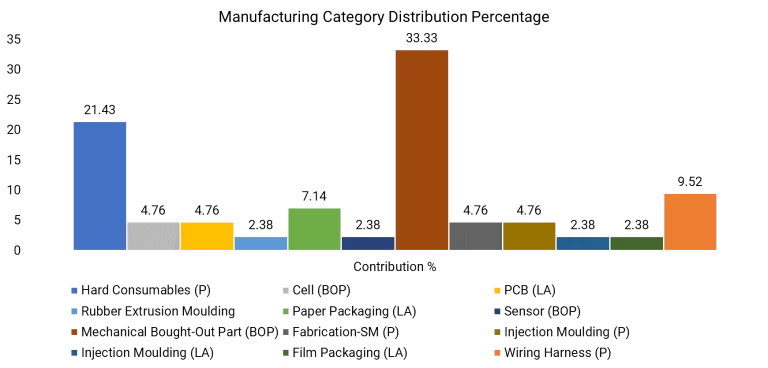
After detailed teardown and analysis of Mi Power Bank 3i, we found inventory has components with different manufacturing categories and its distribution as follows:
- Mechanical Bought-Out Part (BOP): 33.33% Includes outsourced mechanical components essential for functionality
- Hard Consumables: 21.43% Covers adhesive pads, DSAs, and other consumable components
- Wiring Harness: 9.52% Essential for power distribution and communication
- Paper Packaging: 7.14%
- Cell and PCB: 4.76%
- Fabrication and Moulding: 12.9%
03Should Cost Analysis
Should Cost Overview
We recently purchased the Mi 20000 mAh power bank for ?1,609, while it is currently listed on the Mi website for ?1,891. Our estimated should-cost for the product is ?1,436. Additionally, the same power bank was exported from India to Bhutan at ?1,571 in the month of March 2024.
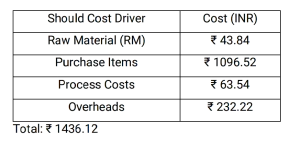
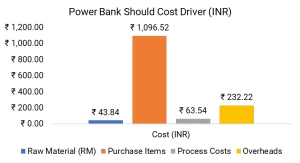
A detailed Should Cost Analysis of Mi Power Bank 3i was performed and the following are the outcomes of the study. The manufacturing cost of the power bank was found to be 1,436 INR and the following were the consideration for the study:
- The Power Bank was manufactured in Bangalore, India
- The volumes considered for the activity were 50,000 annually
- The latest Material rates and rates required for MHR calculations were taken for Q3 FY24-25
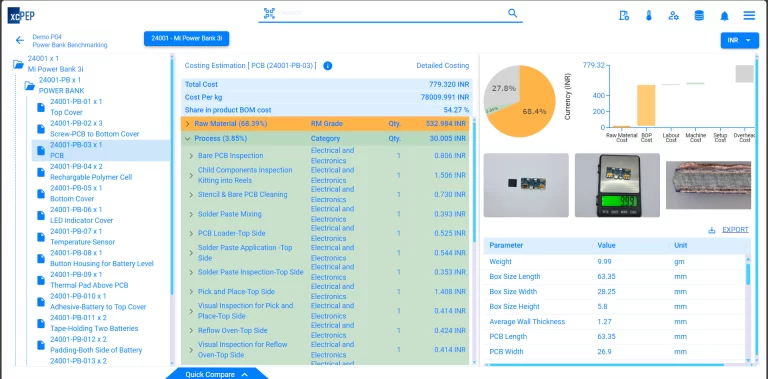
PCB Cost Analysis via xcPEP
Should Cost Breakdown
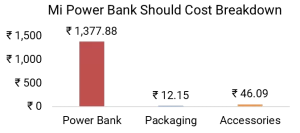
The total should-cost is distributed across the following assemblies:
- Power Bank: 95.94% of total cost (INR 1377.88)
- Packaging: 0.86% (INR 12.15)
- Accessories: 3.20% (INR 46.09)
Cost Pareto Analysis
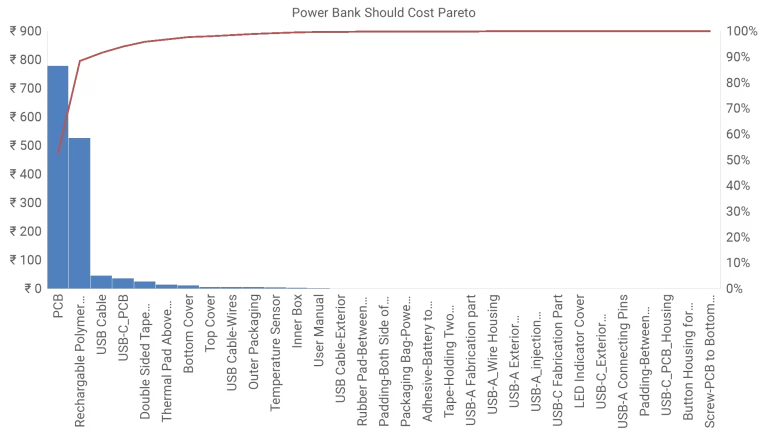
Based on the detailed breakdown of component should cost, following observations are made:
1. Power Bank PCB: The PCB contributes ?779.32, accounting for 54% of the total cost. Its dominance in the should-cost breakdown highlights it as a critical focus area for cost optimization.
2. Rechargeable Polymer Cell Dominance: The Rechargeable Polymer Cell accounts for the highest cost at ?527.09, making up 73% of the overall power bank cost. Its weight and cost contribution highlight its role as a critical driver in the should cost analysis process.
3. USB Cable: The USB Cable, with a cost of ?46.09, represents 6.4% of the total cost, making it the second most expensive component in the analysis.
Key Insight: The top three components (PCB, Rechargeable Polymer Cell, and USB Cable) represent over 93% of the total cost, making them the primary focus for cost-saving measures. Addressing these critical areas can provide substantial cost reductions, improving the overall profitability of the power bank.
By integrating teardown insights, detailed analysis, and benchmarking observations, this comprehensive study underscores the Mi Power Bank 3i's optimized design and functionality.
Software Platforms Used
Should Cost Software
xcPEP delivers real-world accurate, transparent and defensible should cost analysis of mechanical, electrical and electronics components from drawings or physical parts.
Explore xcPEP →
Should CostData
xcPROC is the centralized database engine powering xcPEP. Each database is meticulously curated by a dedicated data research team to be region-specific and time-specific.
Explore xcPROC →