
Kitchen Chimney Teardown & Should Cost Analysis
How to do teardown benchmarking and zero based cost analysis of a home appliance like kitchen chimney. Elica EFL-S601 analysis with approximate manufacturing cost of 7000 INR.
A detailed teardown and should cost analysis of the Elica EFL-S601 Kitchen Chimney. Mapped features, electronics layout, ventilation motor architecture, BOM structure and manufacturing cost.
To demonstrate how xcPEP and xcPROC platforms can be used for zero-based cost analysis of home appliances and reveal cost optimization opportunities in kitchen chimney products.
Elica EFL-S601 kitchen chimney with filterless technology, gesture control, heat auto-clean, 1200 m³/hr suction capacity, and single-phase 3-speed squirrel cage induction motor.
Product features and technology. PCB layout and functional diagrams. Ventilation motor construction. BOM data mapping. Should cost breakdown at INR 7000.


01Product Overview
The Elica kitchen chimney, belonging to the EFL-S601 series, has been designed with several advanced features, making it a versatile and user-friendly kitchen appliance. Here is a summary of its key features:
Filterless Technology
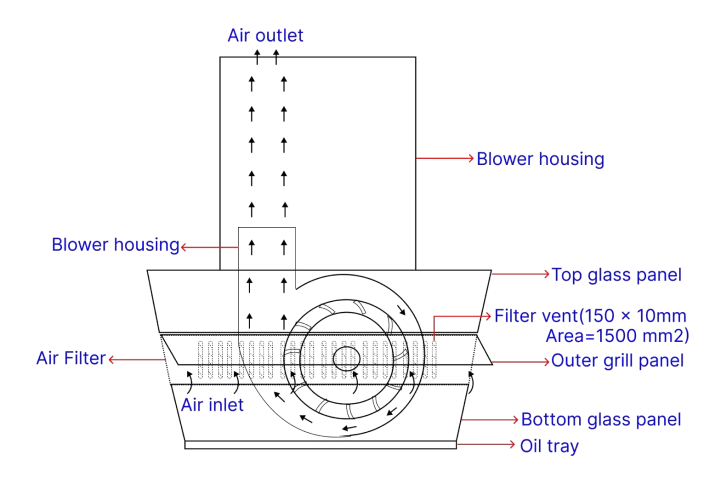
The Elica kitchen chimney features a filter-less design with a special deflector plate. This innovative approach eliminates the need for traditional mesh or baffle filters. The deflector plate redirects and separates oil particles from the vapor, ensuring efficient smoke and grease removal without the maintenance issues associated with conventional filters. This means less cleaning and more convenience for the user.
Gesture Control
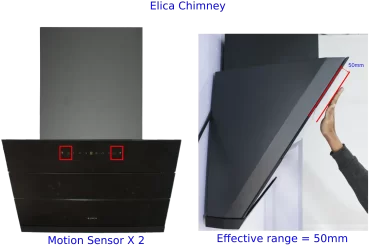
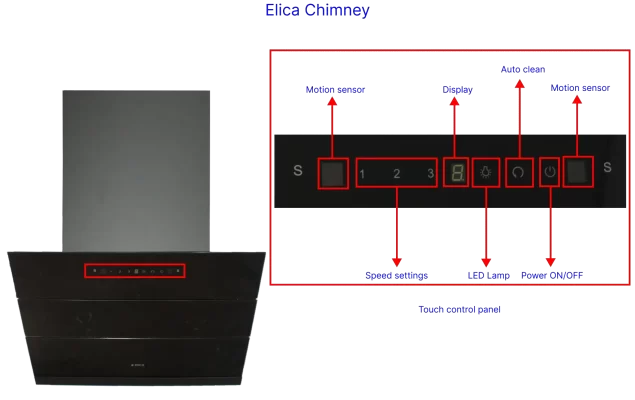
Another notable feature of the Elica kitchen chimney is its gesture control functionality. The chimney is equipped with motion sensors that can detect hand gestures, allowing users to conveniently control the chimney's operation without physically touching the controls. With a simple wave of the hand, the motor speed can be increased or reduced based on leftwards or rightwards motion respectively using non-contact IR sensors.
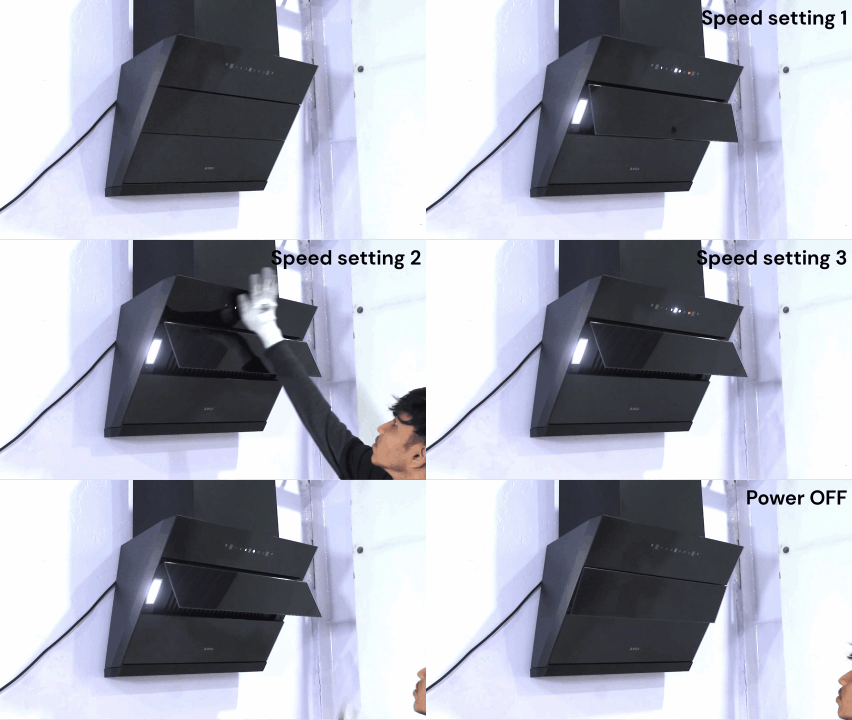
Heat Auto-Clean
The Elica kitchen chimney incorporates a heat auto-clean feature. This technology uses a heating element (heating film attached to the metal frame) to heat up the chimney's interior, melting accumulated oil, and grease deposits. The melted residue is then collected in a removable oil collector tray for easy disposal. This feature significantly reduces the need for manual cleaning and ensures optimal performance over time.
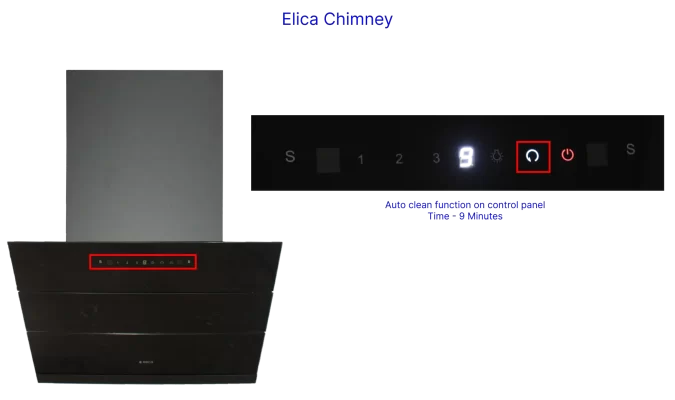

Suction Capacity
The chimney boasts a powerful suction capacity of 1200 m³/hr. The high suction capacity ensures excellent performance in removing smoke, odors, and grease-laden air from the kitchen. It is suitable for Indian-style cooking which involves a lot of frying, tempering, and deep-frying methods.
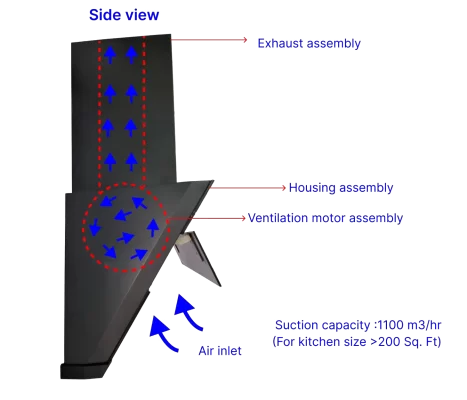
LED Lights
The Elica kitchen chimney includes built-in LED lights for effective illumination of the cooking area. The LED lights provide bright and energy-efficient lighting, enhancing visibility while cooking. They can be controlled using a touch switch located near the power button.
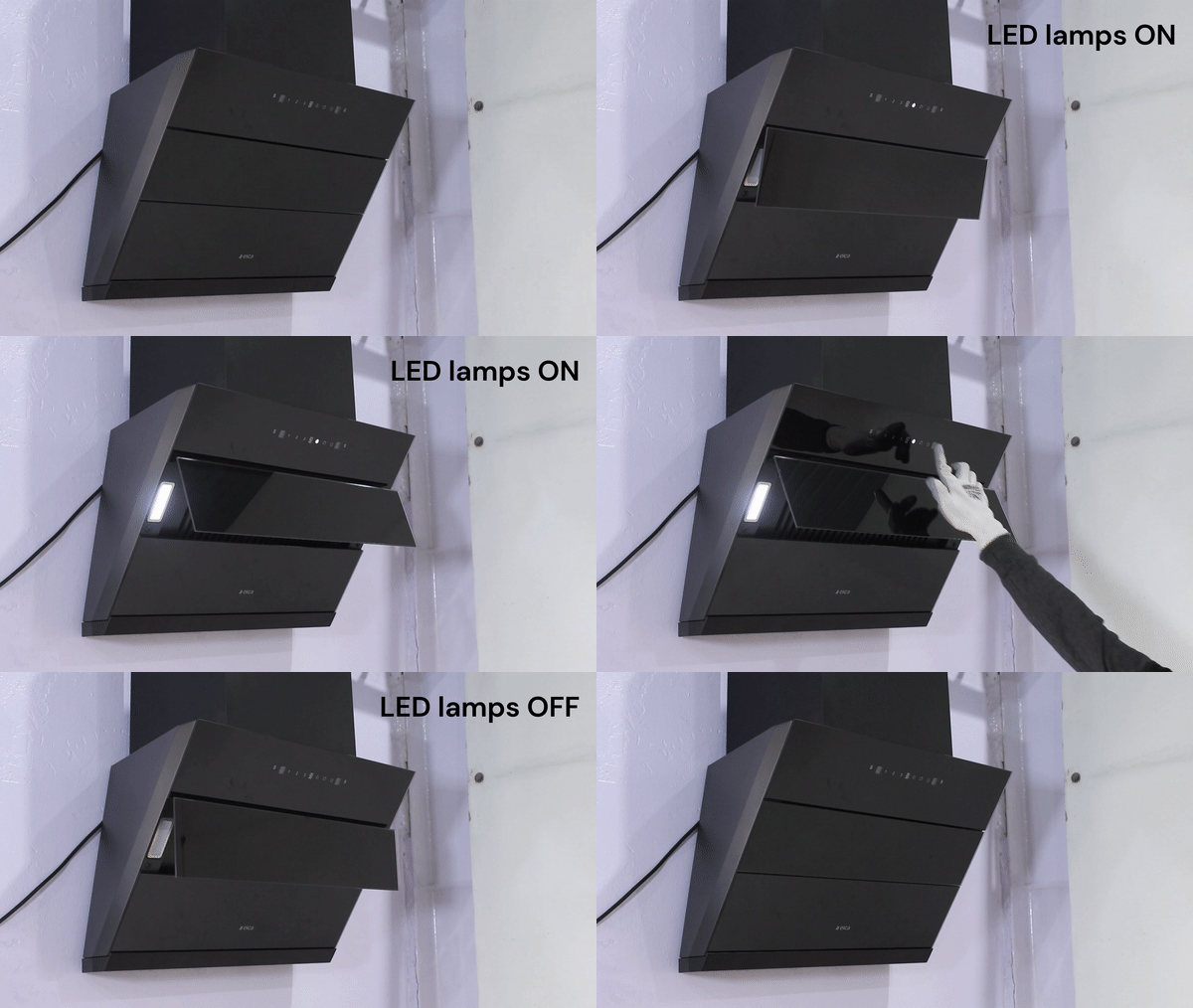
Touch Controls
The chimney features a touch-sensitive control panel for easy operation. The control PCB is operated via touch switches, with each switch corresponding to a specific speed setting. The touch controls provide a sleek, modern interface and are easy to clean compared to traditional button controls.
02Architecture Diagrams
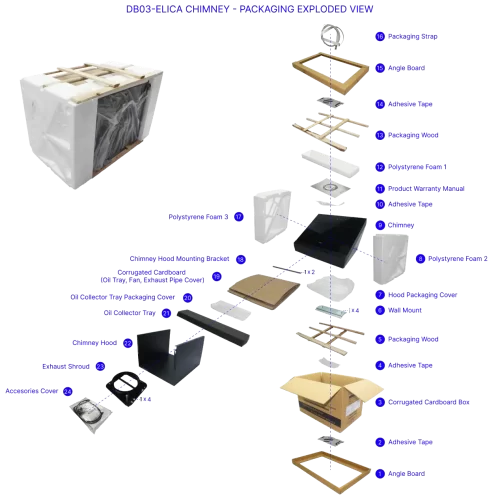
Packaging Diagram
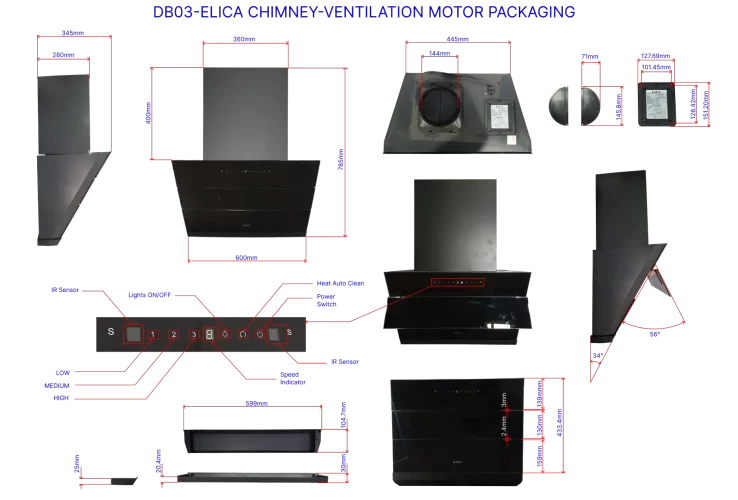
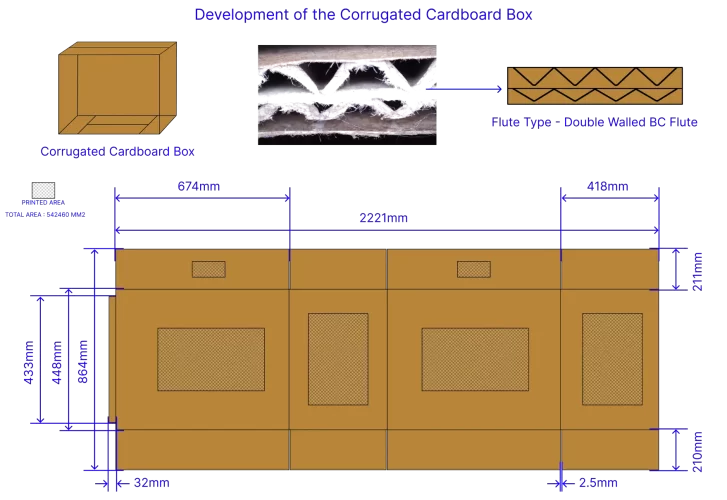
A detailed packaging diagram illustrates how the Elica kitchen chimney is packaged for transportation and delivery. The packaging is designed to protect the chimney during transit and includes protective styrofoam inserts, corrugated cardboard box, and accessory compartments.
Layout Diagram
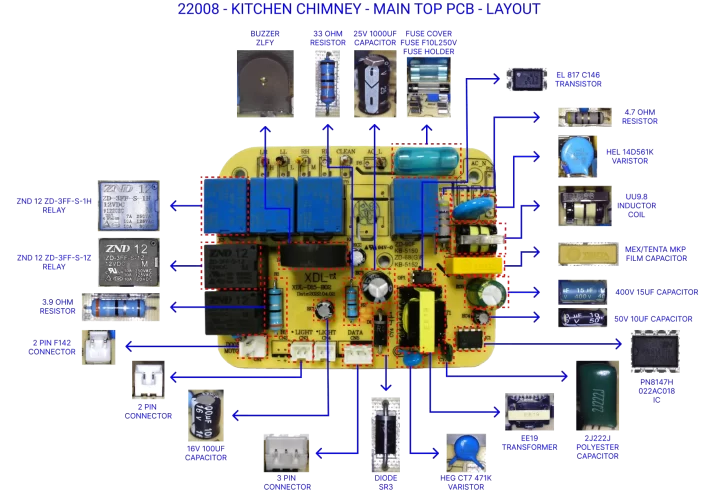
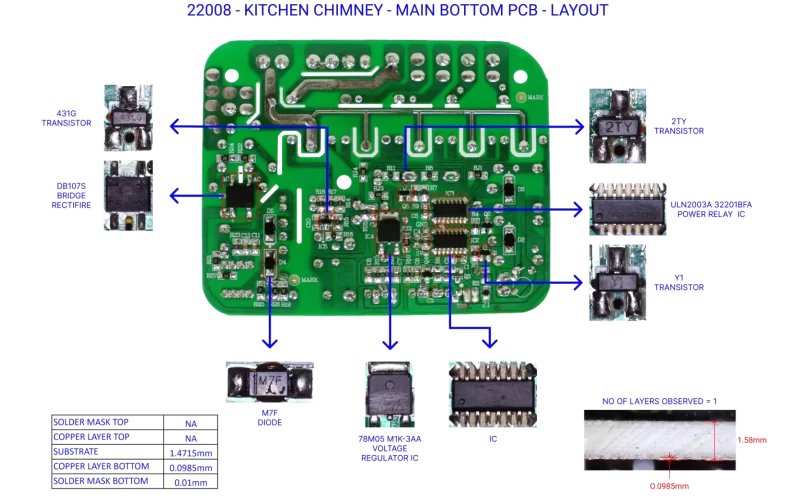
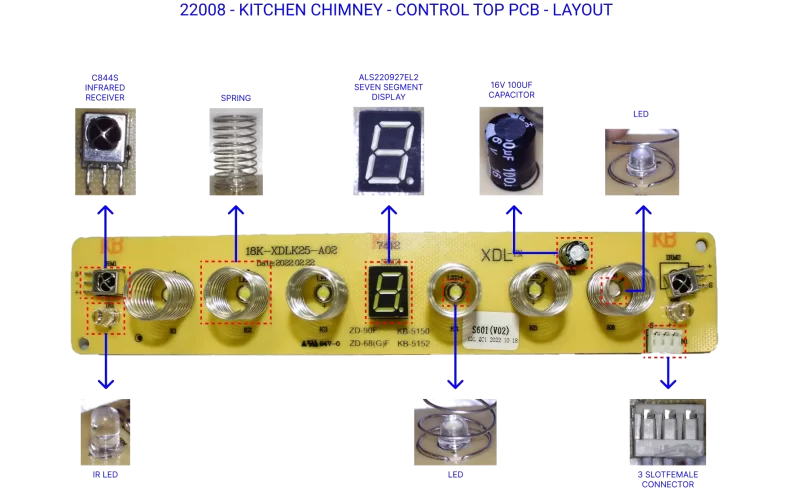
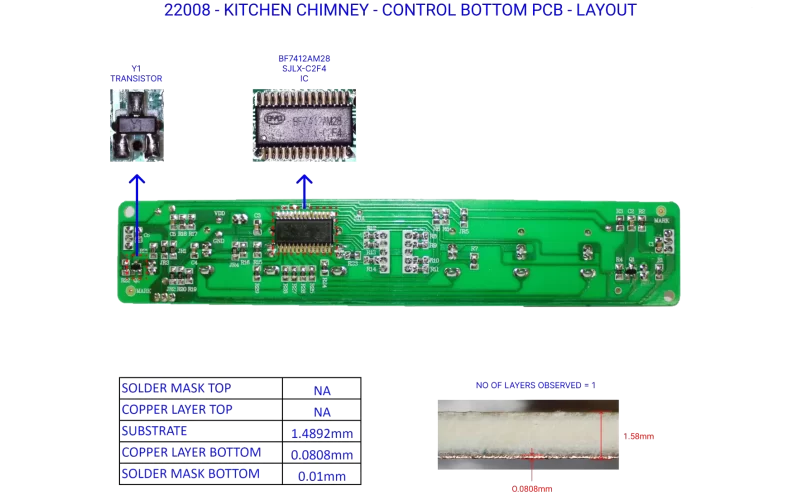
The Elica kitchen chimney comprises two main printed circuit boards (PCBs) and one LED PCB, collectively containing approximately 157 electronic components. These components encompass a variety of elements such as integrated circuits (ICs), relays, and other electronic devices.
To provide a comprehensive understanding of the component layout and their respective positions, accompanying diagrams have been created. These diagrams visually depict the arrangement of the electronic components on the PCBs, highlighting their specific locations and orientations.
Furthermore, the diagrams also include specifications of the electronic components used in the Elica kitchen chimney. This information provides detailed insights into the characteristics and functionality of each component.
Functional Diagram
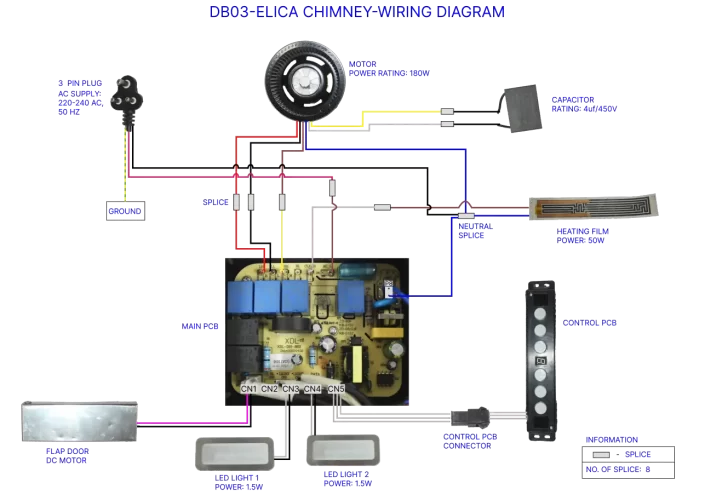
The power button serves as the main control for the Elica kitchen chimney system. When pressed, it turns on the system, activating the various functions. Initially, the ventilation motor remains off, but the motor controlling the motion of the flap is turned on simultaneously. This allows for proper airflow control.
The system offers three speed settings for the ventilation motor. The speed adjustment is achieved by switching ON/OFF relays. When the corresponding speed switch is pressed, a signal from the control PCB is sent to the main PCB. The controller on the main PCB then activates the corresponding relay, which energizes the specific stator winding of the motor for the desired speed adjustment.
The speed control feature can be operated using two different methods. The control PCB can be operated via touch switches, with each switch corresponding to a specific speed setting. Alternatively, there are two non-contact IR sensors placed at the ends of the control PCB. By waving from left to right, the sensors detect the motion and increase the speed, while waving from right to left produces the opposite effect.
The Elica kitchen chimney also includes two LED lights, which can be controlled using a touch switch located near the power button. This allows users to easily adjust the lighting according to their preferences.
Furthermore, the system features an Auto Clean button on the control panel. When pressed, a heating film attached to the metal frame heats up. This heat melts the oils and impurities attached to the chimney's internal cavity, ensuring effective cleaning. The melted oils and impurities are then drained onto a provided tray, which can be manually removed for disposal.
03Motor & Construction
Ventilation Motor
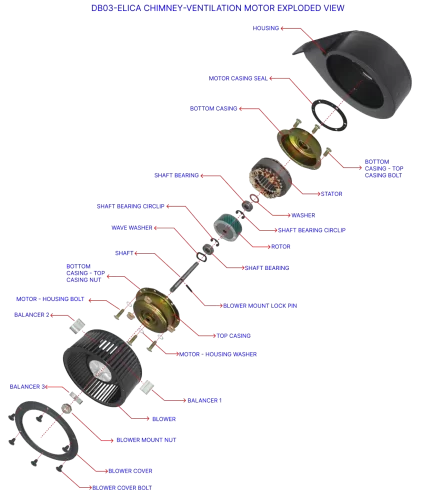
The ventilation motor utilized in the Elica kitchen chimney is a single-phase, three-speed squirrel cage induction motor. This motor is specifically designed to meet the requirements of the chimney's ventilation system, providing efficient airflow control.
The motor is connected to a fabricated cold rolled steel metal blower, The blower is carefully designed to optimize the extraction of smoke, odours, and other airborne particles from the kitchen environment. To ensure the motor's protection and durability, it is enclosed in a metal housing. This housing provides a robust and secure environment for the motor, safeguarding it from external elements and preventing any potential damage or interference.
Single Phase – 3 Speed Squirrel Cage Induction Motor
The Elica kitchen chimney incorporates a single-phase squirrel cage induction motor with a power rating of 180 watts. This motor is specifically designed to operate at three different speeds, providing flexibility and control over the ventilation system.
The squirrel cage design is a common configuration for induction motors, known for its robustness and reliability. It consists of a rotor with short-circuited conductors resembling a squirrel cage, which interacts with the rotating magnetic field produced by the motor's stator. Because the squirrel cage rotor has no winding, the rotor needs no maintenance, low noise and high reliability.
Construction
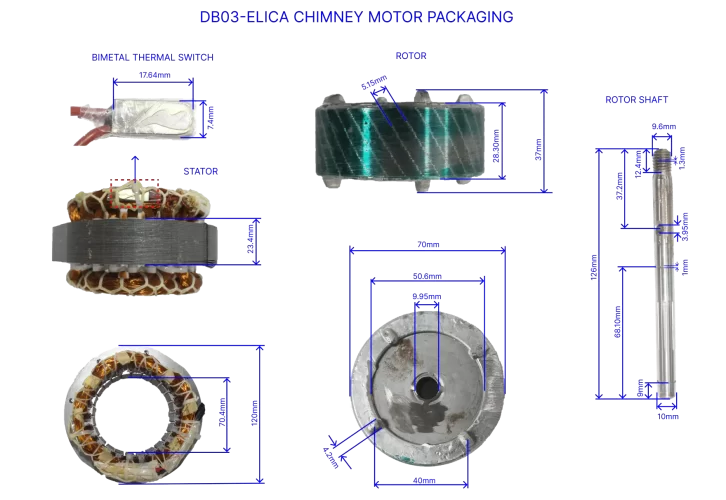
In the construction of the rotor core for the Elica kitchen chimney's single-phase, three-speed squirrel cage induction motor, rotor punching is carried out using progressive stamping. These rotor laminations are then subjected to a steam bluing process. This process serves two purposes: it relieves the stress that may have developed during the punching operation, and it provides a bluish anti-corrosive coating to the laminations.
After the lamination process, the plates are intentionally twisted or skewed by one tooth pitch. This skewing technique helps to reduce magnetic noise and vibrations during motor operation, resulting in smoother and quieter performance.
A Bimetal Thermal switch is used for overheat protection.
04BOM & Should Cost Analysis
Bill Of Materials Study
Our engineering team has performed a comprehensive last-level teardown analysis of the Elica kitchen chimney. Through a meticulous bill of materials (BOM) study, we have systematically documented data on the various part attributes, providing detailed insights into the components of the chimney.
We map product level, sub-assemblies level and part details in very high detail leaving nothing to subjectivity. On the xcPEP platform, these data points are all interlinked which helps in analytics and inference drawing in real time. Parameters for a project are designed with the end objective and corresponding analysis in mind.
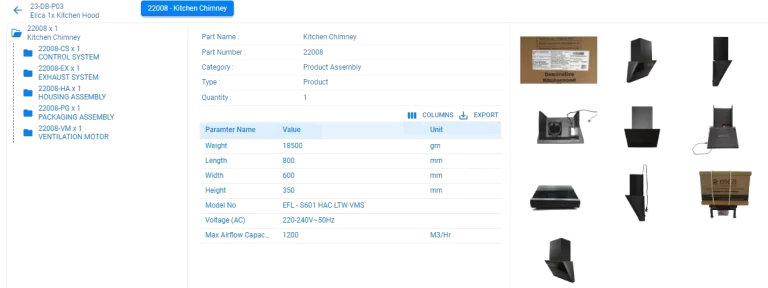
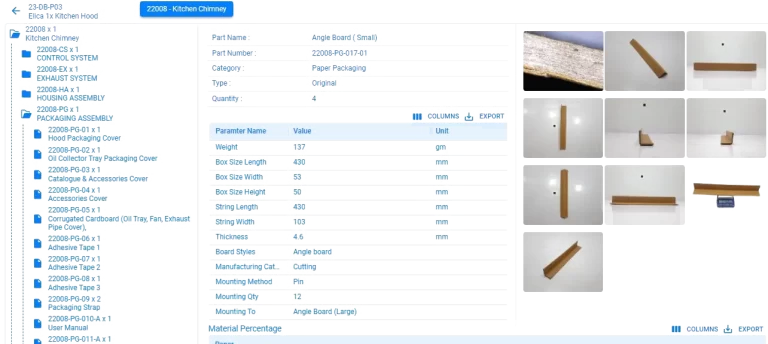
In order to a detailed analysis of the product, we have divided it into sub-assemblies and child parts. Child parts are created in xcPEP based on the manufacturing process categories. Part details like box dimensions, weight, Images, material percentage, and material grade are mapped in BOM.
BOM Data Mapping
Product Level Data is first mapped with details like overall dimensions, weight, manufacturer or supplier details and 8 views of the product with isometric and information images are captured before teardown. After teardown the child parts are created in xcPEP for data map.
Manufacturing Category Distribution Analysis
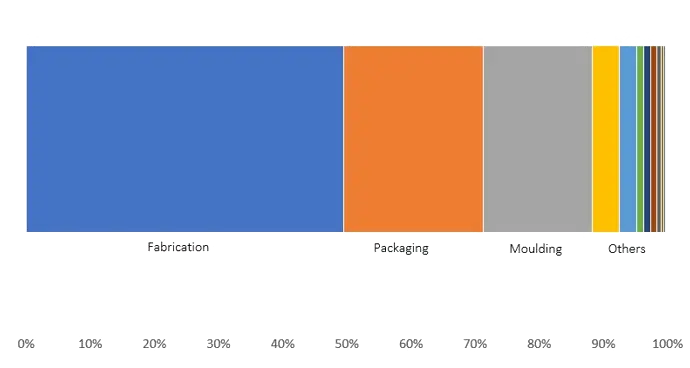
Others-Packaging, Casting, Wiring Harness, Fluid, Gears, Connectors, Rubber/Plastic Extrusion, PCB, Forging
Should Directional Cost Analysis of Elica Kitchen Chimney
A comprehensive should cost analysis (SC) analysis was undertaken to evaluate the manufacturing cost of the Elica Kitchen Chimney. The analysis revealed that the approximate manufacturing cost of the chimney amounted to 7000 INR. Should cost analysis involves creating assumptions and establishing general guidelines to ensure a thorough evaluation. In the case of the Elica Kitchen Chimney, several assumptions were made to facilitate the should cost analysis analysis,
- The Elica Kitchen Chimney is produced in Pune, Maharashtra.
- The study considered an annual volume of 30000 units.
- The latest material rates, labour hourly rates, and machine hour rates were used for the calculations, taken as of May.
- PCB Child parts are considered as bought out in bulk from spot buy sites like Digi key, Mouser Electronics.
- Indian Rupees (INR) currency is used for cost analysis.
- Tool cost is assumed to be paid upfront by the OEM & the total cost of the tool is divided by total number of parts made in a year.
Outcome
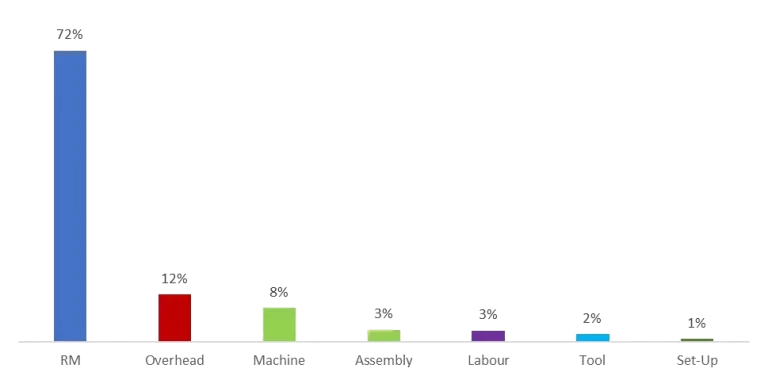
The comprehensive cost analysis of the Elica Kitchen Chimney reveals a detailed breakdown of the manufacturing expenses. The raw material cost accounts approximately 32 % of the total cost. This includes the procurement of high-quality components, electronic parts, mechanical elements, electrical components, and other necessary materials for the chimney's construction.
The process cost accounts for around 17 % of the total cost. This category encompasses expenses related to various manufacturing processes involved in the assembly and production of the kitchen chimney. It includes labour costs for skilled workers, operating costs of specialized machinery and equipment, and expenses associated with quality control measures to ensure superior product standards.
The overhead cost accounts approximately 12 % of the total cost. This category covers indirect expenses incurred during the manufacturing process, such as rent for the facility, utility costs, administrative expenses, maintenance and repairs, and other miscellaneous costs essential for supporting overall manufacturing operations.
High-Cost Parts
Software Platforms Used
Should Cost Software
xcPEP delivers real-world accurate, transparent & defensible should cost analysis of mechanical, electrical & electronics components from drawings or physical parts.
Explore xcPEP →
Should CostData
xcPROC is the centralized database engine powering xcPEP. Built entirely by ASI's data research team, each database is meticulously curated to be region-specific and time-specific.
Explore xcPROC →