
EV Battery Pack Teardown Study & Should Cost Analysis
We conducted a teardown for VA/VE exercise on an electric vehicle battery pack, benchmarking features, BOM, and architecture, and detailing direct costs using the zero-based cost analysis method.
We conducted a detailed teardown study of an electric vehicle battery pack, benchmarking features, generating a comprehensive BOM, mapping the module architecture, and modeling the cost structure through a zero-based approach.
To gather cost and engineering inputs for new product development and to facilitate cost reduction studies of existing products through comparative structural, electronic, and thermal insights.
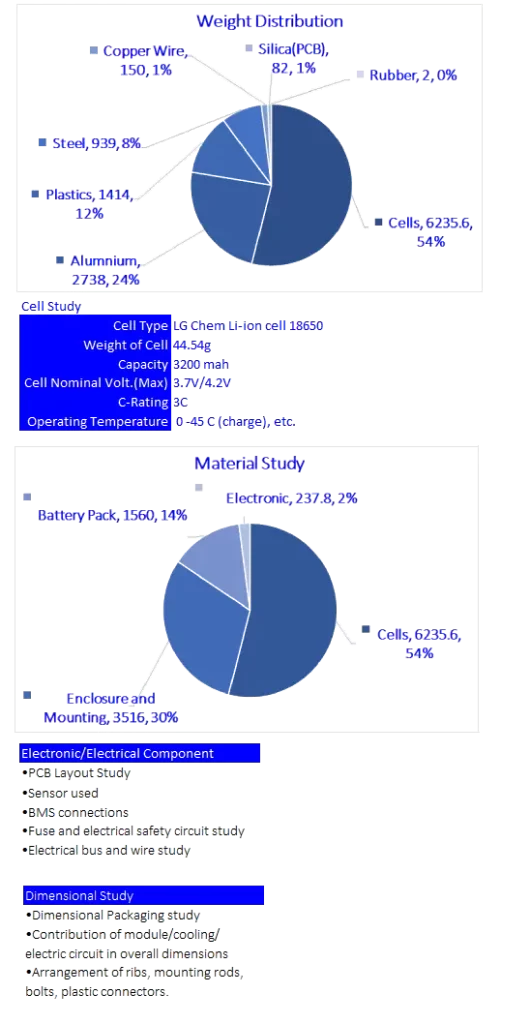
The teardown examined a typical Li-Ion EV battery pack utilized in modern electric vehicles, focusing on cell configuration, structural housing, BMS electronics, wire harnesses, and cooling mechanisms.
Battery pack detailed study frameworks, mechanical modularity concepts, detailed connection/harness structures, BMS & electronic setups, and thermal management via enclosure study.


01Introduction & Overview
Purpose of Study
We conduct detailed teardown study of electric vehicle battery packs typically for two purposes:
- Cost and engineering inputs for new product development.
- Cost reduction study of existing products by comparative teardown study.
Cost insights are generated to understand the cost drivers, supply chain strategies and metrics, commonality study and more. Engineering insights are generated for study or packaging, integration, interface with other subsystems and more.
With growing ecosystem of electric vehicles, demand for better battery pack performance is increasing to provide higher energy density and lifecycle from pack. Battery cells form a major portion of a battery pack, but cell alone cannot guarantee a better performance, as it is very sophisticated. Thus, to utilize battery cells in an optimized way, keeping cost under check, there are multiple parameters that need to be studied to design a battery pack.
Flow of Study
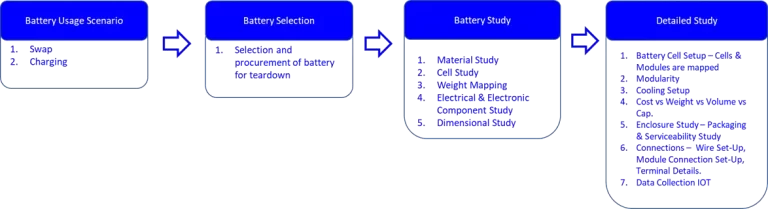
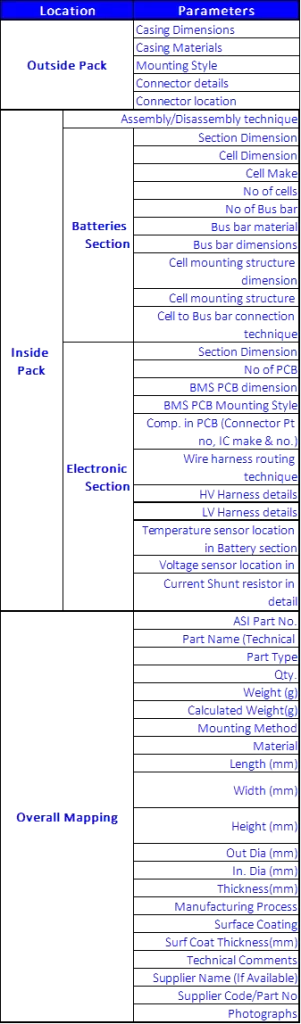
Below is the flow of a study on battery pack which was used as input for design & selection of the battery pack for a vehicle.
02Battery Pack Detailed Study
Teardown Data Collection
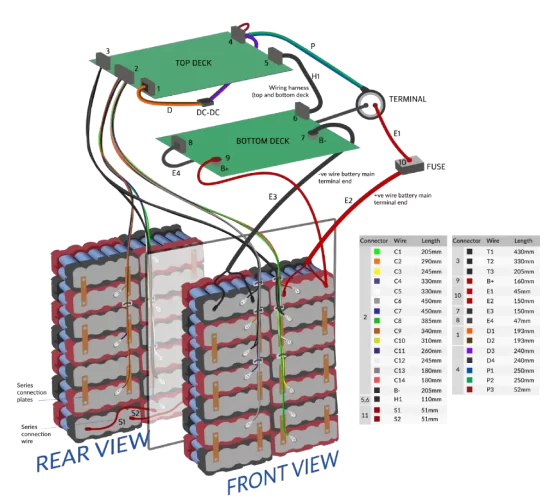
Schematics of the Battery Pack
To start with the first step is to study the battery pack at the assembly level and generate a detailed Layout/schematic to understand the setup and design philosophy.
EV Battery Module Study
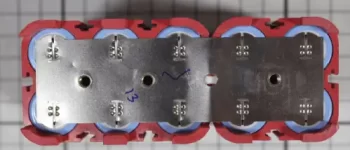
In this we study the arrangement of battery cells in a battery pack based on modules and type of connecting buses. For our sample teardown battery following is the sample representation of a cell module

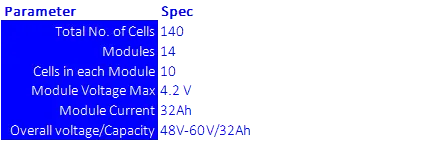
Cells in a module are connected using a thin steel plate (spot welded to cell) and each module is connected using copper bus bars with a mounting screw to plastic modular cell holders.
03Modularity & Connections
Modularity in Packaging of Battery Pack
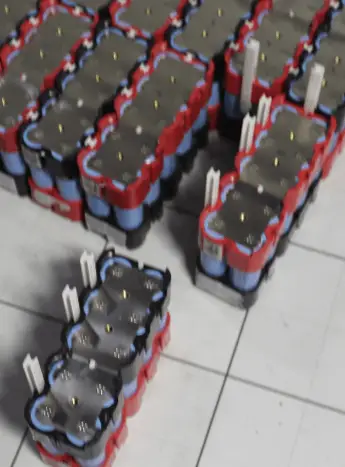
Cells can be increased to more modules without designing new battery holder setup by using the modular battery cell connectors. Modular setup is required for cylindrical cells as their individual capacity is very less but provides flexibility in capacity.
Connections & Harness in the Battery
Wire connections, Module connection setup and Terminal details are studied to understand the overall setup for voltage and current output battery is supposed to provide. This study also gives an understanding of the type of mapping BMS is providing on the battery modules based on connection layout.
Electrical Layout to be drawn for parallel and series.
04BMS & Electronics
PCB Protection

PCB Protection is studied on benchmark battery pack to understand the type of exposure is expected and the type of protection available using PCB coating. This layer looks like a transparent polish over the board and its thickness is calculated in teardown to understand cost and procedure.
This type of layer mainly provides two benefits:
- Saves the PCB board from corrosive elements and fluids and avoids failure due to humidity, corrosion, short circuits, etc.
- To provide higher electrical insulation for PCBs own components which help in high voltage circuit.
BMS & Electronics Set-up
- BMS for following parameters is studied in the teardown parts based on PCB and connection study.
- Cell Balancing this is studied based on the connections by understanding the module level and cell level connections to PCB/BMS board.
- Charging and Discharge Management Connection study helps in understanding the charge/discharge protection availability, whether it is at cell level or module level.
- Circuit Protection provisions type of switches- mosfets, etc.
- Data Storage BMS stores the data points which are stored to use later for troubleshoot/check usage pattern.
- Other sensors used for thermal, impact and humidity mapping to save battery pack.
- Type of controller chips and arrangements.
Sensors & Data Acquisition in EV Battery
- Can be done using a memory card.
In the existing battery memory card arrangement was used to store the data and during charging after battery swapping this data is being collected. - A GPRS/Bluetooth based system to send data to a server
Data is sent to the server from battery automatically using GPRS or Bluetooth connection.
05Enclosure Study - Safety & Cooling
Safety & Cooling Parameters
Each battery pack is dependent on mechanical, thermal and environmental factors to perform in its optimal range. Parameters studied for teardown to understand enclosure capability are:
- Material grade for thermal performance
- Gap and vent availability around cells inside pack for flow.
- Vibration control provisions
- Shock/impact provisions
- Water resistance capability based on type of sealing.
- Serviceability and other mechanical functions in mind.
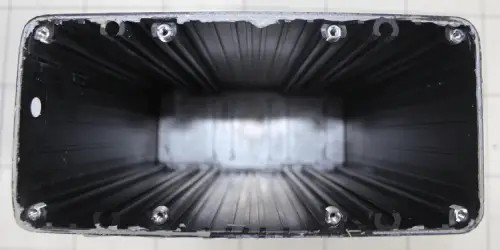
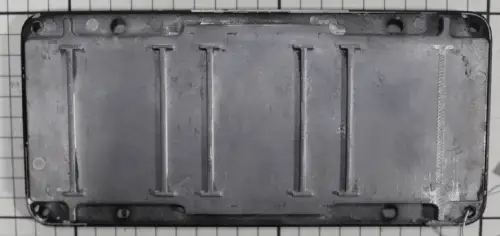
Enclosure is the critical part of battery pack as it provides the above-mentioned characteristic as well as has to provide spacing for wiring and cooling setup (fluid flow) inside the pack. Enclosure is designed in a way to support increase in battery cells without huge change in enclosure design and provides easy accessibility to PCB module for easy serviceability. In our example PCBs were connected in two layers with air gap to provide air cooling as well as arrangement in smaller space.
Software Platforms Used
Should Cost Software
xcPEP delivers real-world accurate, transparent & defensible should cost analysis of mechanical, electrical & electronics components from drawings or physical parts.
Explore xcPEP →
Should CostData
xcPROC is the centralized database engine powering xcPEP. Built entirely by ASI's data research team, each database is meticulously curated to be region-specific and time-specific.
Explore xcPROC →